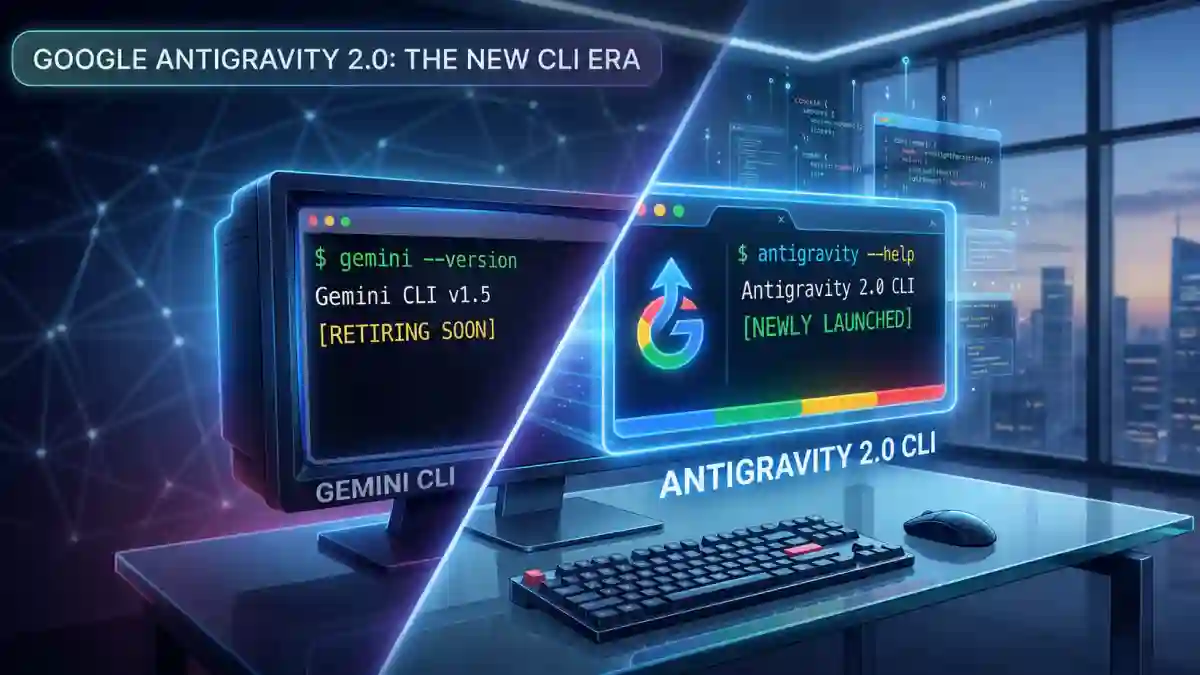
At Google I/O 2026, Google didn’t just announce a new coding tool, they announced a fundamental shift in how software is built. With the launch of Antigravity 2.0 and the retirement of the Gemini CLI, the era of the AI-assisted IDE is over. Welcome to multi-agent orchestration.
1. The Demo That Stole I/O: 93 Agents, One Custom OS, and Doom
If you want to understand the scale of Google’s new Antigravity 2.0 platform, look no further than the live demo at Google I/O.
Google tasked the Antigravity system with a massive challenge: build an entirely new operating system from scratch.
Behind the scenes, Antigravity 2.0 spun up 93 separate sub-agents working in parallel. Over the course of 12 hours, the agents generated 2.6 billion tokens and successfully built the core OS framework. The total API cost? Under $1,000.
But the real mic-drop moment happened live on stage. When the presenter attempted to run the classic game Doom on the newly minted OS, it failed due to missing keyboard drivers. Using live voice transcription, the presenter simply asked Antigravity to build the drivers. Moments later, the game was fully playable.
This isn’t just autocomplete on steroids. It’s an entirely new abstraction layer for software engineering.
2. What is Antigravity 2.0?
When Google first launched Antigravity last year, it was essentially a heavily modified fork of VSCode. It proved that agentic coding worked, but bounding it inside a traditional IDE created friction.
Antigravity 2.0 is a complete rebuild. Available today as a standalone desktop application for macOS, Windows, and Linux, it acts as “Mission Control” for developer teams. You no longer write code alongside an AI; you orchestrate agents that write, test, and deploy code for you.
Here is what makes the 2.0 release a game-changer:
- Powered by Gemini 3.5 Flash: Google’s newest model is the engine under the hood. Optimized specifically for long-running agent workflows, it generates tokens nearly 4x faster than competing models while significantly cutting costs.
- Asynchronous & Scheduled Tasks: You no longer have to stare at a progress bar while an agent works. You can spawn sub-agents to handle large refactors in the background. Even better, Antigravity now supports cron-like scheduling. You can instruct an agent to run a full unit test suite or perform vulnerability checks every night at 2 AM.
- Decoupled from Single Repositories: Agents are now grouped by “Projects” rather than single-folder workspaces. This allows your agents to access and understand context across multiple repositories, enforcing their own settings and permissions along the way.
- Live Voice Transcription: Instead of recording audio files and sending them to a model, Antigravity 2.0 transcribes your voice directly into the prompt box in real-time, making agent direction feel significantly more natural.
3. The Sunset of Gemini CLI
For developers who live in the terminal, Google dropped another major announcement: the highly popular Gemini CLI (which boasts nearly 500,000 installs on its VSCode extension alone) is officially being retired and replaced by the new Antigravity CLI.
While Gemini CLI was instrumental in proving the terminal was a viable interface for AI, developers were hitting a wall. The tool was built for single-turn, sequential conversations. Modern workflows require multi-agent, parallel execution.
Gemini CLI vs. Antigravity CLI
If you are migrating, here is how the two compare:
| Feature | The Outgoing Gemini CLI | The New Antigravity CLI |
|---|---|---|
| Core Architecture | Terminal-native AI assistant | Terminal interface for the Antigravity 2.0 backend |
| Execution Model | Single agent, sequential execution | Multi-agent, parallel orchestration |
| Speed & Workflow | Synchronous (locks your terminal) | Asynchronous (run large tasks in the background) |
| Ecosystem | Standalone tool | Shares the same agent harness as the desktop app |
The new Antigravity CLI is built in Go, making it noticeably faster. More importantly, it keeps the best features of Gemini CLI—like Agent Skills, Hooks, and Subagents—but implements them as Antigravity plugins. Because it shares a backend with the Antigravity 2.0 desktop app, any improvements to your core agents instantly apply across both your GUI and your terminal.
The Bottom Line
Google is sending a clear message: the future of development isn’t about AI helping you write a function; it’s about AI autonomously executing entire engineering pipelines. By moving to a standalone application and a unified CLI, Google is abstracting away infrastructure complexity and turning developers into high-level orchestrators.
Antigravity 2.0 and the new CLI are available now. If you’re still relying on basic code completion, it might be time to level up.