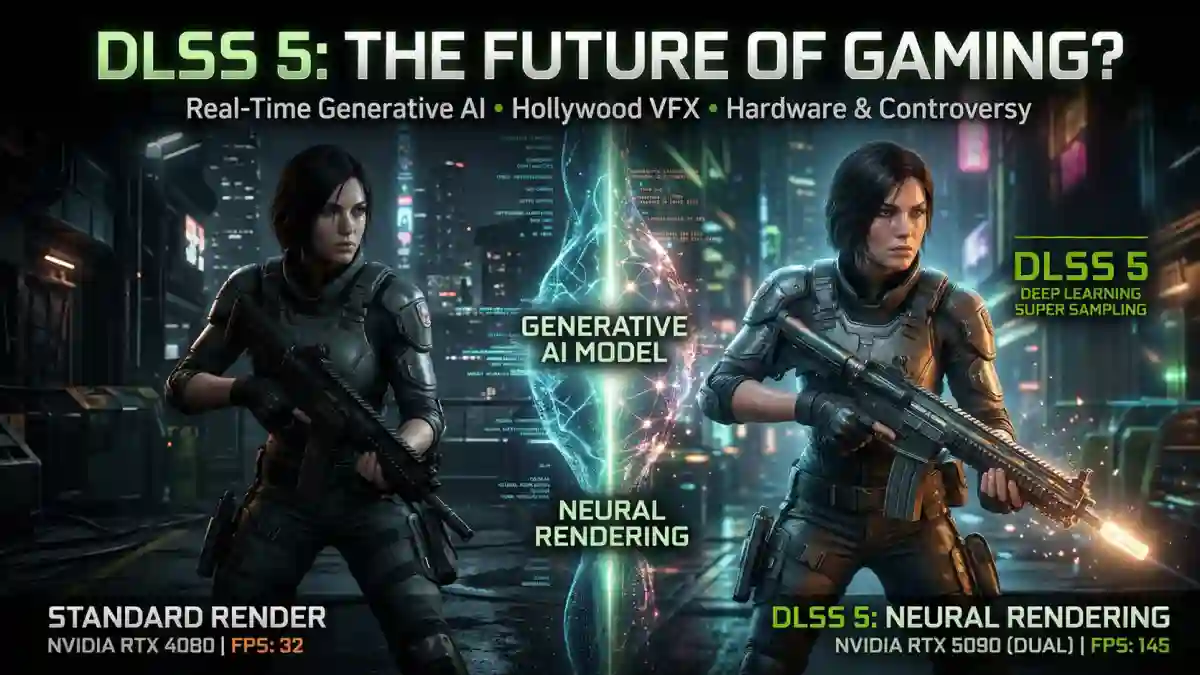
If you’ve been following the latest developments in PC gaming, you’ve likely heard the massive shockwaves coming out of NVIDIA’s GTC 2026 event. NVIDIA just announced DLSS 5, and CEO Jensen Huang is calling it the “GPT moment for graphics.”
But DLSS 5 isn’t just making headlines for its technological leaps—it’s also sparking one of the biggest controversies in modern gaming history. From “yassification” of characters to hardware costs that require a dual-GPU setup, there’s a lot to unpack.
In this complete breakdown, we’ll explore what DLSS 5 is, how it works, and why the internet is currently at war over its AI-driven future.
What Exactly is DLSS 5?
Since its inception, DLSS (Deep Learning Super Sampling) has primarily been about performance.
- DLSS 1 to 3.5 focused on upscaling lower-resolution images and generating new frames to boost FPS without sacrificing visual clarity.
- DLSS 4.5 introduced Multi-Frame Generation.
DLSS 5 is a complete pivot. It is a real-time neural rendering model.
Instead of just making the game run faster or look sharper, DLSS 5 actively redraws the game to look like Hollywood-level VFX. It analyzes the scene to understand what objects are made of—hair, fabric, translucent skin—and then uses generative AI to infuse those pixels with hyper-realistic lighting, subsurface scattering, and material textures.
How Does DLSS 5 Work? (The Tech Behind the Magic)
When NVIDIA first revealed DLSS 5, there was a lot of confusion about what the AI was actually doing under the hood. Following intense scrutiny, NVIDIA engineers confirmed the three-step process:
- The Input: The game engine renders a standard 2D frame and passes that, along with motion vector data, to the DLSS 5 AI model.
- The Inference: The neural network analyzes this 2D image and “infers” the geometry and materials. It guesses what is skin, what is metal, and where the light sources are located.
- The Output: The AI acts as a real-time, ultra-advanced post-processing filter. It “paints” over the original render with photorealistic lighting, skin glow, and material bounce, outputting the final frame at up to 4K resolution.
This shift from simple upscaling to generative rendering is why Jensen Huang compares it to GPT; it’s not just processing data, it’s creating visual information.
The DLSS 5 Controversy: “AI Slop” and Artistic Intent
While the technology is undeniably powerful, the gaming community’s reaction has been largely hostile. The GTC 2026 demo showed DLSS 5 running on titles like Resident Evil Requiem, Starfield, and Hogwarts Legacy, and gamers immediately noticed something glaring: DLSS 5 changed the characters.
The “Yassification” Effect
In Resident Evil Requiem, character Grace Ashcroft was suddenly rendered with darker hair roots and what looked like applied makeup. This “beautification” filter effect has led to accusations of the AI stripping away the original grit and character design intended by the developers.
AI Hallucinations
Because the AI relies on a 2D frame rather than deep engine geometry, testing revealed that it occasionally “hallucinates” details that aren’t supposed to be there. This can lead to artifacts or visual elements that clash with the game’s original art direction.
The Hardware Cost
Adding fuel to the fire, the mind-blowing demo NVIDIA showed was running on a massive dual-RTX 5090 setup. One GPU was dedicated entirely to running the DLSS 5 AI model, leading to fears that this technology will be inaccessible to anyone without a multi-thousand-dollar rig.
NVIDIA’s Defense: Evolution, Not Replacement
NVIDIA isn’t backing down. CEO Jensen Huang strongly pushed back against the criticisms, stating that detractors are “completely wrong.”
He compared the current backlash to the skepticism surrounding Ray Tracing when it launched in 2018, which is now an industry standard. NVIDIA claims that the final tool gives developers granular, direct control over the AI—allowing them to adjust color intensity, grading, and masking so their aesthetic isn’t lost.
Furthermore, NVIDIA promises that by the time it launches, DLSS 5 will be optimized to run on a single GPU.
DLSS 5 Release Date & Supported Games
If you’re looking to try this out yourself, here is the current roadmap for NVIDIA’s next-gen tech:
- Release Window: Fall 2026.
- Hardware Compatibility: While unconfirmed, it is heavily expected to be locked to the new RTX 50-series architectures (like the RTX 5090 and 5080) due to the immense AI processing power required.
- Confirmed Launch Titles:
- Resident Evil Requiem
- Assassin’s Creed Shadows
- Delta Force
- Phantom Blade Zero
- Starfield
- Hogwarts Legacy
- The Elder Scrolls IV: Oblivion (Remastered)
The Bottom Line: Future or Folly?
DLSS 5 is an incredibly ambitious gamble. If NVIDIA can tame the AI hallucinations and put real control back into the hands of developers, it could genuinely bridge the gap between video games and cinematic CGI.
However, if it remains an aggressive “beautify” filter that overwrites artistic intent, it might just go down as the most expensive, hardware-intensive Snapchat filter ever created.